Ravi Shankar never called himself a jazz musician, yet few people did more to open jazz to Indian music. His 1962 album with flautist Bud Shank, his influence on John Coltrane, and the students he trained all fed the style now called Indian jazz fusion. This guide answers the questions listeners most often ask about that link.
Did Ravi Shankar play jazz?
No. Ravi Shankar was a Hindustani classical sitar player, and he stayed one. What he did was record and share stages with jazz musicians, most notably on the 1962 album Improvisations, and his playing shaped how jazz artists such as John Coltrane thought about modes, drones and long improvisations.
The distinction matters. In Shankar’s collaborations, the Indian music usually kept its own rules: a raga with its ascending and descending phrases, a rhythmic cycle played on tabla, and a drone underneath. The jazz musicians met him on that ground rather than the other way round.
What was Improvisations (1962)?
Improvisations is a 1962 World Pacific album on which Ravi Shankar played with American jazz musicians. Bud Shank played flute, and bassist Gary Peacock, guitarist Dennis Budimir and drummer Louis Hayes joined on the track “Fire Night.” It is often cited as one of the first recorded Indian–jazz collaborations.
The album opens with “Improvisation on the Theme Music from Pather Panchali,” built on Shankar’s music for Satyajit Ray’s 1955 film. “Fire Night” sets jazz players improvising over Indian percussion, and the second half of the record returns to classical form with a three-part Raga Rageshri (alap, jor and gat). Tabla, tampura and dholak players complete the lineup.
How did Ravi Shankar influence John Coltrane?
Coltrane was drawn to Indian music as he developed modal jazz. On 3 November 1961 he recorded “India” at the Village Vanguard in New York, using two double bassists to imitate a Hindustani drone. He named his son Ravi, born in 1965, after Shankar, and the two musicians met in 1965 after years of letters.
“India” came out on the album Impressions (Impulse!, 1963). Reggie Workman and Jimmy Garrison held the drone on two basses while Coltrane and Eric Dolphy on bass clarinet improvised over it. By 1962, Coltrane’s playing was drawing on Indian and Arabic scales within a modal framework, which is why his music from that period is still a common entry point for jazz listeners exploring raga.
Why do raga and modal jazz fit together?
Both build long improvisations over a fixed tonal centre instead of fast chord changes. A raga sets the notes, the characteristic phrases and the mood; modal jazz sets a scale and holds it. That shared idea gave Shankar and Coltrane’s generation a practical meeting point.
There are real differences. A raga is more than a scale: it has rules about which notes to stress, how to approach them and when in the day it is traditionally played. Modal jazz is looser. Musicians who play both styles well learn to respect the raga’s grammar while keeping jazz’s freedom to change direction.
How did Shankar reach Western audiences?
Through festivals, recordings and teaching. He played the Monterey Pop Festival in 1967, Woodstock in 1969 and the Concert for Bangladesh in 1971. He won a Grammy for West Meets East with violinist Yehudi Menuhin, and founded the Kinnara School of Music in Mumbai in 1962, adding a Los Angeles branch in 1967.
Those appearances put the sitar in front of rock and jazz audiences at the same time. Shankar went on to win four Grammy Awards in total, plus a Lifetime Achievement Award.
Who carried the connection forward?
Students and collaborators. Collin Walcott studied sitar with Shankar and tabla with Alla Rakha at UCLA, then co-founded the band Oregon around 1970 and played electric sitar on Miles Davis’s On the Corner (1972). Shankar’s daughter, Anoushka Shankar, appeared on Herbie Hancock’s The Imagine Project (2010).
Other musicians took the idea in different directions: guitarist John McLaughlin’s group Shakti, formed with tabla player Zakir Hussain in 1975, is covered in The Spiritual Jazz of John McLaughlin and Shakti. For the wider story, see our guide What Is Indian Jazz Fusion?
How does Melodic Intersect continue this tradition?
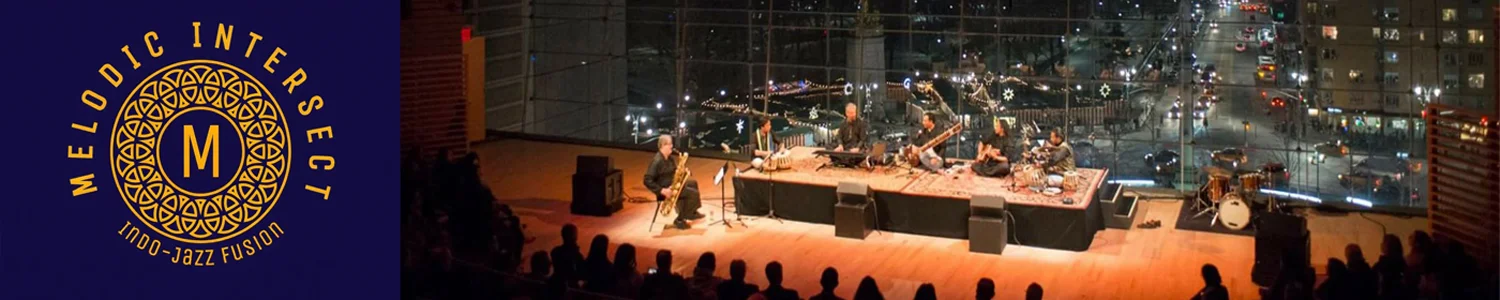
Melodic Intersect pairs Indian classical musicians with a jazz musician, the arrangement Shankar’s collaborations pointed toward. Sitar player Hidayat Khan and tabla player Enayet Hossain play with jazz pianist and Hammond organist Greg Hatza on the band’s trio albums.
Hear the sitar and piano together on Timeless Reflections (2024), Beyond Borders (2025) and Woven Paths (2026), or browse the full discography.
What should I listen to first?
Start with Shankar and Bud Shank’s Improvisations (1962), then Coltrane’s “India” on Impressions (1963) and Miles Davis’s On the Corner (1972). For a present-day version of the same meeting, play Melodic Intersect’s Beyond Borders.
Melodic Intersect is available to book for concerts, festivals and private events.