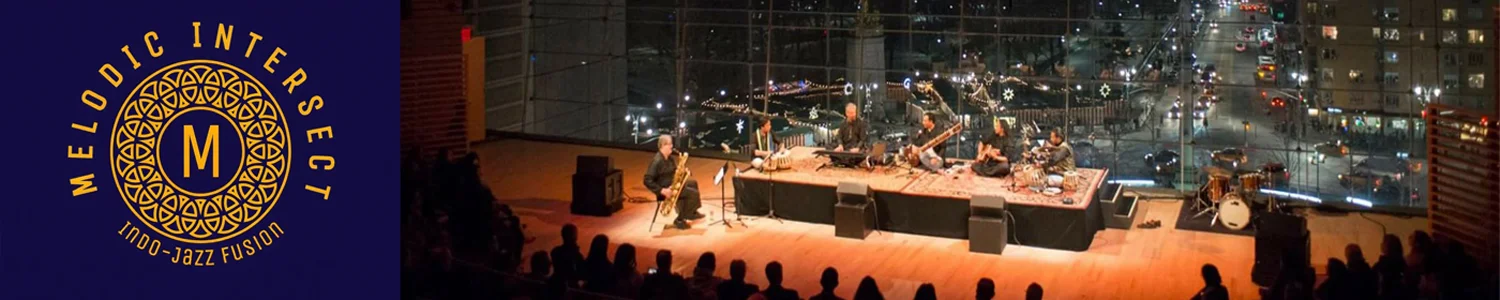
Indian jazz fusion — sometimes called Indo-jazz — is a style of music that combines the melodic and rhythmic systems of Indian classical music with the harmony and improvisation of jazz. It’s the genre this website’s own band, Melodic Intersect, plays: tabla, sitar, and jazz piano in conversation. This guide answers the questions people most often ask about it.
What is Indian jazz fusion?
Indian jazz fusion is a genre that pairs the raga-based melodies and taal-based rhythms of Indian classical music with the chord-driven harmony and spontaneous improvisation of jazz. Musicians trained in one tradition learn to “speak” the other, so a sitar might improvise over a jazz chord progression, or a jazz pianist might learn to follow a tabla player’s rhythmic cycle.
It isn’t a single fixed sound — Indo-jazz recordings range from acoustic duets to electric, rock-influenced bands — but every version of it shares that same basic move: putting an Indian classical instrument or musician in direct musical dialogue with a jazz one, rather than just sampling or quoting Indian music from the outside.
Where did Indian jazz fusion come from?
Indian jazz fusion grew out of a series of one-off collaborations in the 1960s and 70s that gradually became a genre of their own, as musicians on both sides — Indian classical players and American and British jazz musicians — sought each other out deliberately rather than by accident.
Saxophonist Joe Harriott and violinist John Mayer recorded an album called Indo-Jazz Fusions in London in 1966 — one of the first releases to use the term. Sitar player Ravi Shankar had already worked with alto saxophonist Bud Shank in 1961, and went on to influence John Coltrane, who studied Indian music and named his son Ravi Coltrane after him. Guitarist John McLaughlin, who had played electric fusion in the Mahavishnu Orchestra, formed the acoustic group Shakti in 1975 with tabla player Zakir Hussain, violinist L. Shankar, and ghatam player Vikku Vinayakram — widely considered the moment Indian jazz fusion became a genre in its own right rather than a series of experiments. Melodic Intersect’s own blog covers this history in more detail: see Indian Jazz Fusion – The Beginning, The Spiritual Jazz of John McLaughlin and Shakti, and The Pulse of the World: Zakir Hussain’s Journey.
What is raga, and how is it different from a jazz scale?
A raga is a melodic framework in Indian classical music — a set of specific ascending and descending note sequences, along with rules about which notes to emphasize, that a musician improvises within. Unlike a Western jazz scale, a raga is also tied to a mood and, traditionally, a time of day, and it develops slowly, note by note, rather than running through chord changes.
Where jazz improvisation is usually built around a chord progression that changes every few beats, a raga performance often holds a single tonal center for an extended stretch, exploring it in depth before moving on. That’s one reason Indo-jazz fusion often sounds more spacious, or more meditative in its opening minutes, than a straight-ahead jazz tune: the raga sets the harmonic ground, and the improvisation happens on top of it rather than through fast-moving chords.
What does the tabla contribute to jazz fusion?
The tabla is a pair of small, tuned hand drums — a wooden treble drum (the dayan) and a metal or clay bass drum (the bayan) — that together provide the rhythmic backbone of North Indian classical music, playing complex, cyclical rhythmic patterns called taal.
In a fusion setting, the tabla brings two things a standard jazz drum kit doesn’t: precisely tuned pitches (so the drum itself can interact melodically, not just rhythmically) and taal’s cyclical structure, which counts time in patterns of odd numbers — 7, 11, or more beats to a cycle — instead of jazz’s more common 4/4 or 3/4. That rhythmic complexity is a hallmark of the genre, and it’s the instrument at the center of Melodic Intersect’s own sound: founder Enayet Hossain plays tabla.
What does the sitar contribute to jazz fusion?
The sitar is a long-necked, plucked string instrument with a set of main playing strings and a second set of “sympathetic” strings underneath that vibrate in resonance, giving the instrument its distinctive, ringing sustain. It’s the lead melodic voice of Hindustani (North Indian) classical music, capable of the pitch-bends and ornaments a raga requires.
In fusion, the sitar often takes the role a saxophone or guitar would play in a jazz band — carrying the melody and taking improvised solos — but its sliding pitch and sustained resonance give those solos a different color and phrasing than either instrument can produce. Melodic Intersect’s sitar player, Hidayat Khan, comes from a family of sitar players going back seven generations; his father was the sitar player Ustad Vilayat Khan.
Who are the key pioneers of Indian jazz fusion?
The clearest lineage runs from sitar player Ravi Shankar’s 1960s crossover recordings, through saxophonist Joe Harriott and violinist John Mayer’s 1966 Indo-Jazz Fusions album, to guitarist John McLaughlin’s Mahavishnu Orchestra (which brought Indian-inflected, odd-meter playing into electric jazz-rock) and then his acoustic group Shakti, formed in 1975 with tabla player Zakir Hussain, violinist L. Shankar, and ghatam player Vikku Vinayakram.
Zakir Hussain, son of the tabla legend Ustad Alla Rakha, became the genre’s most visible ambassador over the following five decades, recording with musicians from Béla Fleck to the Grateful Dead’s Mickey Hart. Read more about his career on the blog: The Pulse of the World: Zakir Hussain’s Journey from Diga Rhythm Band to Global Fusion.
How does Melodic Intersect fit into this tradition?
Melodic Intersect, based in Baltimore, Maryland, continues the tradition Shakti helped establish: a working band built around Indian classical instrumentalists — tabla player Enayet Hossain and sitar player Hidayat Khan — playing alongside a jazz musician, pianist and Hammond organist Greg Hatza, rather than a jazz act simply borrowing Indian instrumentation for one track.
The band has released 12 albums since 2013, moving between full-trio recordings and a pair of tabla-and-piano duo albums (Hand-Talk and Talking Hands). Its most recent release is Woven Paths (2026). See the full discography to hear how the sound has developed across more than a decade.
What should I listen to first?
If you want to hear where the genre started, Shakti’s self-titled 1976 debut and John Coltrane’s late-career recordings with Indian influences (via his study of Ravi Shankar) are the classic starting points. If you want to hear where it stands today, Melodic Intersect’s own catalog — from Eastern Visions (2013) through Woven Paths (2026) — is a direct continuation of that lineage, recorded by musicians actively working in both traditions.
The band is available to book for concerts, festivals, and private events as well.
Keep reading
- Ravi Shankar and Jazz: Bud Shank, Coltrane and Beyond
- Indo-Jazz Fusions: How Joe Harriott and John Mayer Named a Genre
- The Tabla in Jazz: Rhythm Cycles (Taal) Explained for Jazz Listeners
- Sitar Meets Jazz: From the 1960s to Today
- Raga vs. Jazz Modes: How Improvisers Bridge Two Systems
- 25 Essential Indian Jazz Fusion Albums (1962 to Today)
- Hammond Organ Meets Tabla: A Jazz Organ in Indian Fusion
- Remember Shakti, L. Shankar and Trilok Gurtu: The Second Wave
- Indian Jazz Fusion in America: From New York to Baltimore
- Inside Woven Paths: A Track-by-Track Guide to the 2026 Album
- Live Music for Diwali, Weddings and Cultural Events: Why Indian Fusion Works
Sources & further reading
- Melodic Intersect: Indian Jazz Fusion – The Beginning, The Spiritual Jazz of John McLaughlin and Shakti, The Pulse of the World: Zakir Hussain’s Journey
- Shakti (band) — Wikipedia
- Mahavishnu Orchestra — Wikipedia
- Songlines, “The 10 Best Tabla Fusion Albums”
- Melodic Intersect discography and artist bios