In mid-1960s London, a Jamaican alto saxophonist and a Calcutta-born violinist put a jazz quintet and five Indian musicians on one stage and called the result Indo-Jazz Fusions. Joe Harriott and John Mayer’s double quintet was one of the first standing bands built on that idea, and its name still describes a whole style. Here is its story.
What was Indo-Jazz Fusions?
Indo-Jazz Fusions was a London ensemble led by composer and violinist John Mayer and alto saxophonist Joe Harriott. It was a ten-piece “double quintet”: a jazz quintet and five Indian musicians playing together. Between the mid-1960s and 1968 it released three albums on Columbia in the UK, with US editions on Atlantic.
The group did not simply add an Indian instrument to a jazz band. Its two halves were equal in size, and its music was written by a composer trained in both Western classical music and Indian music.
Who was John Mayer?
John Mayer (1930–2004) was a composer and violinist born in Calcutta. He won a scholarship to London’s Royal Academy of Music in 1952, played violin in the London Philharmonic (1953–58) and Royal Philharmonic (1958–65) orchestras, and also played sitar. He later taught composition at Birmingham Conservatoire.
Mayer studied in Calcutta and Bombay before moving to London, where he studied composition with Mátyás Seiber. At Birmingham, where he taught from 1989, he introduced a Bachelor of Music course in Indian music in 1997. He died in London on 9 March 2004.
Who was Joe Harriott?
Joe Harriott (1928–1973) was an alto saxophonist born in Kingston, Jamaica, who became one of the most original jazz musicians in Britain. Before Indo-Jazz Fusions he led a free-form quintet, recording Free Form (1960), Abstract (1963) and Movement (1963).
His free-form work is now credited with influencing European free jazz, although his profile in the United States stayed smaller than in Europe. He died in Southampton, England, on 2 January 1973, aged 44.
What records did Indo-Jazz Fusions make?
Three albums: Indo-Jazz Suite (mid-1960s; sources date it 1965 or 1966), Indo-Jazz Fusions (1967) and Indo-Jazz Fusions II (1968). The double quintet also wrote “Acka Raga,” the theme of the BBC quiz show Ask the Family, which featured Mayer on sitar and was broadcast from 1967 to 1984.
Mayer released a separate record, Shanta Quintet, in 1967. The three Indo-Jazz Fusions albums are the core of the group’s catalogue, and the easiest place to hear how its two halves interact.
How was it different from other 1960s Indo-jazz experiments?
Most early meetings were one-off encounters. Ravi Shankar’s Improvisations (1962) brought jazz players into a classical Indian setting, and John Coltrane’s “India” (recorded 1961) evoked Indian music with a jazz band alone. Indo-Jazz Fusions was a standing ensemble with an equal Indian half.
That is the model most later groups followed: Indian classical musicians and jazz musicians working in the same band, playing composed material that leaves room for both traditions to improvise. Read more about the earlier meetings in Ravi Shankar and Jazz.
Did the band continue after the 1960s?
Yes, in a new form. In the 1990s, Mayer’s students Richard Dray, Will Joss and Simon Gray revived the band as John Mayer’s Indo Jazz Fusions, then Mayer led it himself, with his son Jonathan Mayer on sitar. It kept performing until Mayer’s death in 2004.
Why does the name still matter?
The group’s title put “Indo-jazz” on record sleeves in the 1960s, and many listeners still use that word for the style. It named a way of working, Indian and jazz musicians as equal partners, as much as a sound.
Our guide What Is Indian Jazz Fusion? places the group alongside Ravi Shankar, John McLaughlin’s Shakti and today’s bands.
Who continues this approach today?
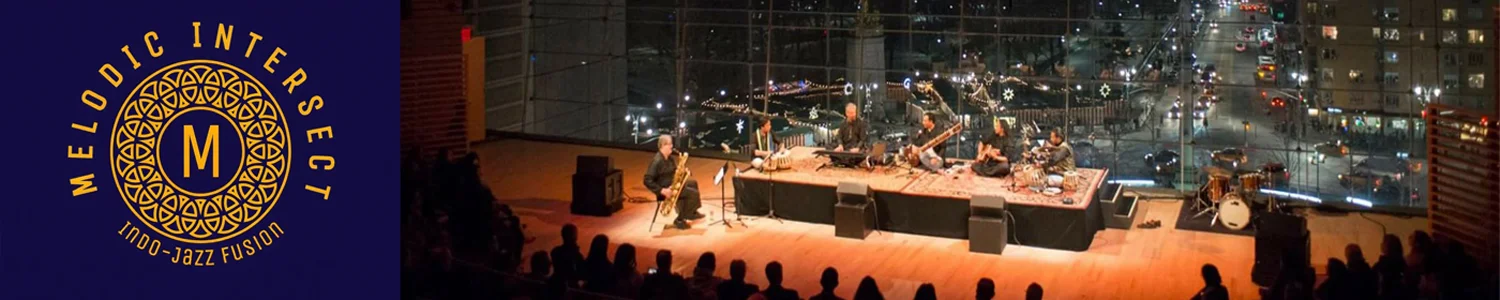
Melodic Intersect, based in Baltimore, is built the same way on a smaller scale. Tabla player Enayet Hossain and sitar player Hidayat Khan, both trained in Hindustani classical music, play with jazz pianist and Hammond organist Greg Hatza.
Hear the full trio on Beyond Borders (2025), explore the discography, or book the band for a concert or festival.