If you’re organising a Diwali celebration, an Eid gathering, a wedding reception or a campus cultural night, the music has to suit a mixed audience: guests who grew up with Indian classical music, guests who never have, and children. Indian jazz fusion often fits that brief well. This guide explains why and walks through the practical questions to settle before you book any live band.
Why does Indian fusion music work for cultural events?
Because it speaks to two audiences at once. The sitar and tabla are instantly recognisable to South Asian families, and the jazz side (piano, organ, grooves and improvisation) gives everyone else a familiar way in. Nobody needs a guide to enjoy it, and the connoisseurs in the room will hear real ragas and rhythmic cycles.
It’s also flexible in mood. A slow, drone-based opening suits a dinner or a lamp-lighting, and a fast tabla-driven piece can lift a room later in the evening. For background on the style itself, see What Is Indian Jazz Fusion?
What kind of music suits a Diwali celebration?
Diwali, the festival of lights, is celebrated by Hindus, Jains, Sikhs and Newar Buddhists, usually between mid-October and mid-November. It centres on lamps (diyas), rangoli, sweets, feasts and family gatherings, and it has become a major cultural event for the diaspora.
That shape suggests the music: something warm and unhurried while guests arrive and eat, and something celebratory once the lamps are lit. A trio can play a reflective opening set and a livelier second set. Tell the band about the running order of your evening, such as a puja, speeches or a dinner service, so the sets fit around it.
What about Eid and other community celebrations?
Eid al-Fitr marks the end of the Ramadan fast. Its celebrations are about family visits, community gatherings, special food and sweets, and generosity. As with Diwali, live music at an Eid event is usually hospitality music: it should welcome people, leave room for conversation and suit every generation present.
Instrumental music has an advantage here: there are no lyrics to check for language or appropriateness, and the music does not compete with conversation. A trio of tabla, sitar and piano or Hammond organ can carry a whole evening without a singer; if you’d like vocals, ask, because the expanded line-up can include them.
Is Indian jazz fusion right for a wedding?
It works best at the reception, the cocktail hour or a pre-wedding evening, where people are listening and talking rather than performing rituals. Many Hindu weddings have their own music around the ceremony itself, such as the groom’s procession with dancing and music. Plan the live band around those traditions, not in place of them.
Ask for a mix: a recognisable raga-based piece for the older relatives, something groove-driven for the dance-minded, and quiet pieces for dinner. Share any special requests early so the band can prepare them.
How big a band do we need?
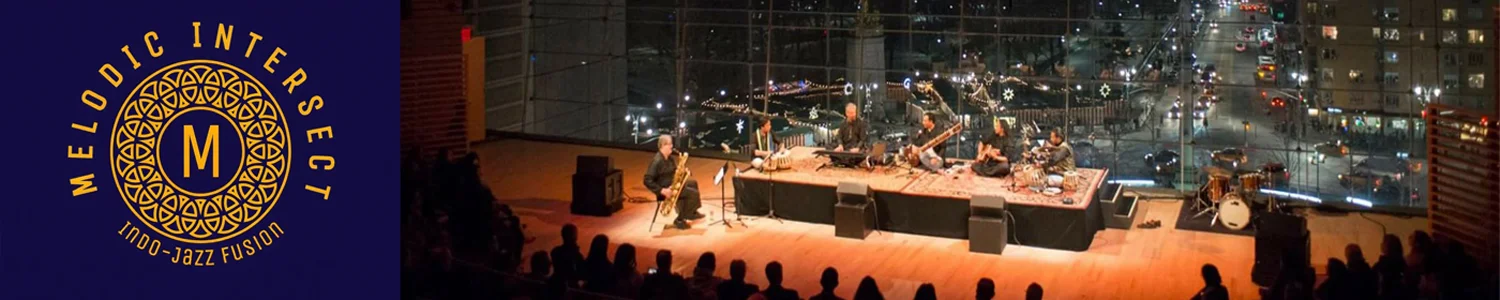
Match the band to the room and the budget. Melodic Intersect’s core is a trio (Enayet Hossain on tabla, Hidayat Khan on sitar and Greg Hatza on piano and Hammond organ), and for larger stages it can expand to up to seven musicians, adding guitar, santoor, sarangi, vocals or more percussion.
For a living room, a temple hall or a small restaurant, the trio can play an acoustic or reduced-volume set. For a festival stage or a ballroom, the larger line-up fills the space.
What should we sort out before booking?
- Date and lead time. Give at least a month’s notice, and more for festival season. Diwali dates move every year with the lunar calendar.
- Venue and sound. Tell the band the room size, whether there’s a stage and a sound system, and any volume limits. A technical rider (the band’s stage and sound needs) comes to the organiser once the booking is confirmed.
- Running order. Share when speeches, rituals, dinner and dancing happen, so the sets fit around them.
- Travel. Melodic Intersect is based in Baltimore, Maryland, and travels worldwide; include your location when you enquire.
- Listening first. Every album is on Spotify, Apple Music and YouTube, and videos of past concerts are on the Media page.
Where has Melodic Intersect played?
Past performances include Jazz at Lincoln Center (the IndoJazz festival, sold out) and Joe’s Pub in New York, Le Moyne College and Syracuse University in Syracuse, An die Musik LIVE in Baltimore, the Annapolis Boat Club, the Annapolis Jazz & Roots Festival, the Howard County Arts Center, the Arts Council of Princeton and the Plymouth Playhouse in Minnesota.
That range, from colleges to jazz clubs, churches, arts centres and festivals, is the best guide to what the band can adapt to. Full dates are on the Tour page.
How do we book?
Use the form on the Book page and include your event date, location and event type; the band will follow up. If you’d like to hear the music first, start with Beyond Borders (2025) or the newest album, Woven Paths (2026). For the longer story, Ravi Shankar and Jazz is a good introduction to where this music comes from.
Sources
- Diwali — Wikipedia
- Eid al-Fitr — Wikipedia
- Hindu wedding — Wikipedia
- Book Melodic Intersect (formats, lead time, travel, past venues)
- Melodic Intersect tour dates