Shakti, the 1970s band of John McLaughlin, L. Shankar, Zakir Hussain and Vikku Vinayakram, broke up after three albums. Its ideas didn’t stop there. Through the 1980s and 1990s its members, and players who came up in its wake, carried Indian jazz fusion forward on their own records, and in 1997 the band came back as Remember Shakti. This is the story of that second wave.
What happened to Shakti after the 1970s?
The original Shakti began in 1973 as a partnership between English guitarist John McLaughlin and Indian violinist L. Shankar. It released Shakti with John McLaughlin and A Handful of Beauty in 1976 and Natural Elements in 1977, and disbanded after 1978.
The members went their own ways, and each took part of Shakti’s sound with them. For the band’s first chapter, read John McLaughlin and Shakti.
Who is L. Shankar?
Lakshminarayana Shankar, who also records as Shenkar, was born in Madras (now Chennai) in 1950 into a family of musicians; his brother is the violinist L. Subramaniam. He co-founded Shakti and was the band’s melodic voice alongside McLaughlin.
He invented the stereophonic double violin, a ten-string instrument built by luthier Ken Parker that covers the range of a string section from bass to treble. His ECM albums, including Who’s to Know (1980), Vision (1984) and Song for Everyone (1985, with Jan Garbarek, Zakir Hussain and Trilok Gurtu), are among the best-known records of the post-Shakti years. He also worked with Frank Zappa and on Peter Gabriel’s Passion, and his 1995 album Raga Aberi was Grammy-nominated.
Who is Trilok Gurtu?
Trilok Gurtu, born in Mumbai in 1951, is the son of the singer Shobha Gurtu. He built a hybrid percussion set that combines tabla with a Western drum kit, played without a stool in a half-kneeling position on the floor, and he’s known for dipping cymbals and strings of shells into a bucket of water.
After Collin Walcott’s death in 1984, Gurtu joined the band Oregon and played on Ecotopia (1987), 45th Parallel (1989) and Always, Never and Forever (1991). He also played in McLaughlin’s trio of the 1980s (heard on Live at the Royal Festival Hall, 1990), made his solo debut with Usfret (1988), and later worked with Jan Garbarek and Joe Zawinul. He won the Down Beat Critics Poll for percussion repeatedly between 1994 and 2002.
What was Zakir Hussain doing between the two bands?
Building a career that made the tabla a global instrument. Zakir Hussain, the son of tabla master Alla Rakha, had moved to San Francisco in the late 1960s. After Shakti he recorded Making Music (ECM, 1987) with Hariprasad Chaurasia, McLaughlin and Garbarek, and he later worked with Charles Lloyd, Tabla Beat Science and his Masters of Percussion ensemble.
In 1999 he received the National Heritage Fellowship, the highest US honour for traditional artists. The tabla’s place in all of this is covered in The Tabla in Jazz.
What is Remember Shakti?
Remember Shakti is the band McLaughlin and Hussain formed in 1997, after a twenty-year gap, to revive Shakti’s acoustic Indian fusion. McLaughlin couldn’t locate L. Shankar for the reunion, so the first line-up added the bansuri (bamboo flute) of Hariprasad Chaurasia, with Vikku Vinayakram on ghatam.
The band’s albums are Remember Shakti (1999), The Believer (2000) and Saturday Night in Bombay (2001), followed by a live recording from the 2004 Montreux Jazz Festival.
Who joined in the second line-up?
Three musicians who defined the later sound:
- U. Srinivas (1969–2014) pioneered the electric mandolin in Carnatic music, using single strings to suit its ornaments. He gave his first concert at nine and played the Berlin Jazz Festival at thirteen. McLaughlin said working with him was “one of the greatest experiences of my life.”
- V. Selvaganesh, Vikku Vinayakram’s son, plays kanjira (a South Indian frame drum) and mridangam.
- Shankar Mahadevan, the singer and film composer of the Shankar–Ehsaan–Loy trio, became the band’s full-time vocalist by 2001.
How did the story come full circle?
In 2020 the band re-formed under its original name. Shakti’s This Moment (2023), with McLaughlin, Hussain, Mahadevan, Selvaganesh and violinist Ganesh Rajagopalan, was its first studio album in 46 years, and it won the 2024 Grammy for Best Global Music Album.
At that ceremony Hussain became the first Indian musician to win three Grammys in one night. He died in San Francisco in December 2024. McLaughlin announced Mind Explosion in 2025 as the band’s final album.
Where should I start listening?
Take one record from each thread: L. Shankar’s Song for Everyone, Trilok Gurtu’s Usfret, Zakir Hussain’s Making Music, Remember Shakti’s Saturday Night in Bombay and Shakti’s This Moment. Our list of 25 essential Indian jazz fusion albums puts them in the wider timeline.
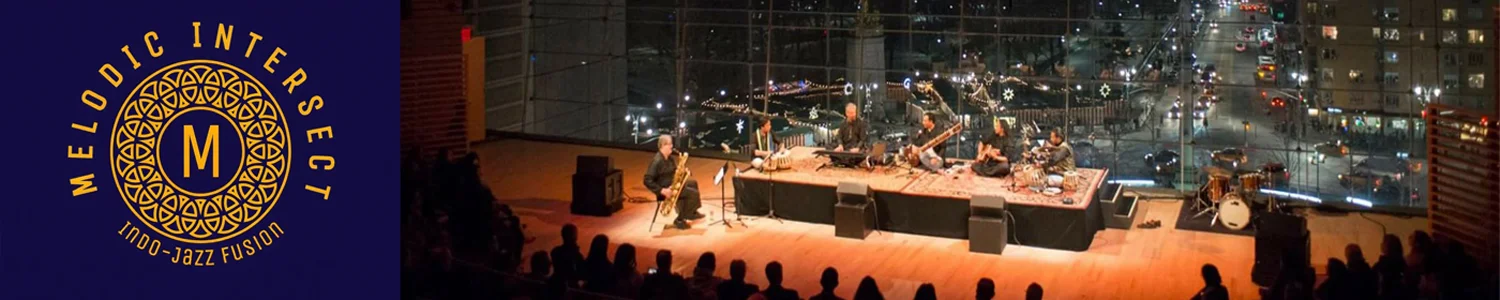
Melodic Intersect grew out of this lineage: Indian percussion and melody in equal conversation with a Western instrument. Hear it on Beyond Borders, read What Is Indian Jazz Fusion? for the full history, or book the band.
Sources
- Shakti (band) — Wikipedia
- Remember Shakti — Wikipedia
- L. Shankar — Wikipedia
- Trilok Gurtu — Wikipedia
- Oregon (band) — Wikipedia
- Zakir Hussain (musician) — Wikipedia
- Making Music (Zakir Hussain album) — Wikipedia
- Hariprasad Chaurasia — Wikipedia
- U. Srinivas — Wikipedia
- V. Selvaganesh — Wikipedia
- Shankar Mahadevan — Wikipedia
- This Moment (Shakti album) — Wikipedia