Indian jazz fusion is often told as a British or Indian story, but much of it happened in the United States: in a New York museum in 1955, a Los Angeles studio in 1962, a Greenwich Village jazz club, a Long Island college, and the San Francisco Bay Area. This is a map of the American scene, from the first Indian classical records made here to today’s musicians between Baltimore and New York.
When did Indian classical music reach American audiences?
In 1955. The sarod master Ali Akbar Khan came to the United States that year at the invitation of the violinist Yehudi Menuhin, and on April 18, 1955, at the Museum of Modern Art in New York, he recorded what is generally described as the first album of Indian classical music issued in the West.
Ravi Shankar followed with his first US tour in 1956, playing to small audiences and explaining the music as he went. For the next decade the two musicians built the audience that Indian jazz fusion would later play to.
Where did Indian music first meet American jazz?
On both coasts in the early 1960s. In New York, John Coltrane’s quartet recorded “India” live at the Village Vanguard in November 1961, with two bassists holding a drone. In Los Angeles, Ravi Shankar recorded Improvisations for the World Pacific label in 1962, with the flautist Bud Shank and, on one track, the jazz rhythm section of Gary Peacock and Louis Hayes.
The rest of that story, including why modal jazz and raga fit together, is in Ravi Shankar and Jazz.
Why did California become a centre for Indian music?
Because the musicians settled and taught there. Ali Akbar Khan opened a branch of his Ali Akbar College of Music in Berkeley in 1967 and moved it to San Rafael in 1968. Ravi Shankar opened a western branch of his Kinnara School of Music in Los Angeles in 1967, the year he played the Monterey Pop Festival.
Zakir Hussain moved to San Francisco in the late 1960s, and he said he learned as much from the Grateful Dead’s drummer Mickey Hart as from his classical studies. In 1976 Khan and Hussain recorded Karuna Supreme with the American alto saxophonist John Handy.
What role did New York play in the 1970s?
It was where the fusion went electric and where Shakti began recording. Miles Davis recorded On the Corner at Columbia’s New York studio in 1972, with Badal Roy on tabla and two electric sitarists. On July 5, 1975, Shakti recorded its first album live at Southampton College on Long Island.
That album, Shakti with John McLaughlin, introduced American listeners to Zakir Hussain, L. Shankar and Vikku Vinayakram. Read the band’s story in John McLaughlin and Shakti and its sequel in The Second Wave.
Who are the Indian-American jazz musicians?
The generation born to Indian immigrants in the 1970s turned the fusion from a meeting of guests into a home-grown American music. Two figures stand out:
- Rudresh Mahanthappa, an alto saxophonist raised in Boulder, Colorado, studied with the Carnatic saxophonist Kadri Gopalnath. Their album Kinsmen came out in 2008. He received a 2007 Guggenheim Fellowship to explore how Carnatic music informs American jazz, and he now directs jazz at Princeton University.
- Vijay Iyer, a pianist born in Albany, New York, and raised near Rochester, has worked with Mahanthappa since 1996. His trio album Tirtha, with the guitarist Prasanna and the tabla player Nitin Mitta, was recorded in Brooklyn. He received a MacArthur Fellowship in 2013 and joined Harvard’s faculty in 2014.
Is Indian jazz fusion recognised in America today?
Yes, at the highest level. At the 2024 Grammy Awards, Zakir Hussain won three awards in one night, including Best Global Music Album for Shakti’s This Moment and Best Contemporary Instrumental Album for As We Speak, his album with the American musicians Béla Fleck and Edgar Meyer. He was the first Indian musician to do so.
Earlier honours tell the same story. Hussain received the National Heritage Fellowship, the highest US award for traditional artists, in 1999, and Ali Akbar Khan was the first Indian musician to receive a MacArthur Fellowship, in 1991.
Where does Baltimore fit in?
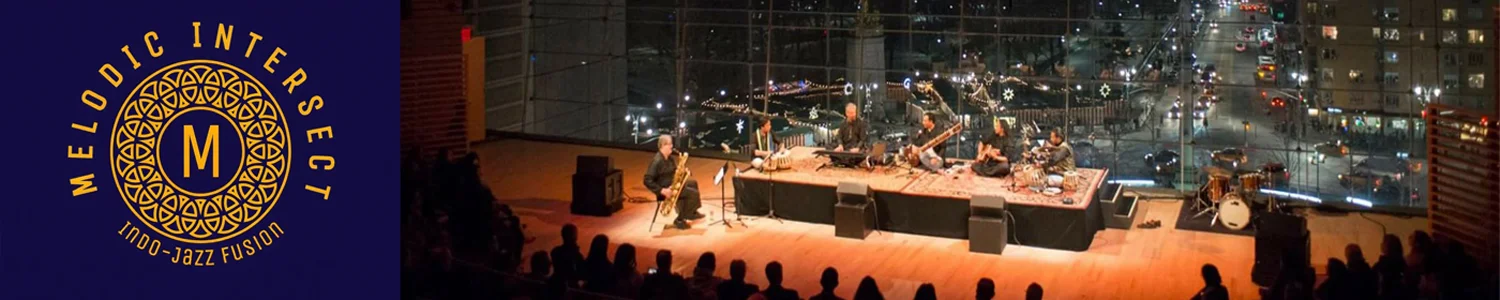
Melodic Intersect is Baltimore’s contribution. The band was founded in 2013 by tabla player Enayet Hossain; its core trio adds Hidayat Khan on sitar and Greg Hatza, a Peabody-trained jazz organist, on piano and Hammond organ. It has released 12 albums and plays regularly across the Mid-Atlantic, including at An die Musik LIVE in Baltimore, the Howard County Arts Center, the Annapolis Jazz & Roots Festival and the Arts Council of Princeton.
In New York the band has played Joe’s Pub and Jazz at Lincoln Center, where its IndoJazz festival concert sold out, and it has taken the music to Le Moyne College and Syracuse University upstate and to the Plymouth Playhouse in Minnesota. See every date on the Tour page.
Where can I hear it?
Start with the American landmarks: Improvisations, “India”, Shakti with John McLaughlin, Karuna Supreme, Kinsmen and Tirtha. All of them are in our list of 25 essential Indian jazz fusion albums.
Then hear the Baltimore chapter on Beyond Borders or Woven Paths. To bring the band to your city, book Melodic Intersect. For the whole history in one place, read What Is Indian Jazz Fusion?
Sources
- Ali Akbar Khan — Wikipedia
- Ravi Shankar — Wikipedia
- Impressions (John Coltrane album) — Wikipedia
- Improvisations (Ravi Shankar album) — Wikipedia
- Zakir Hussain (musician) — Wikipedia
- Karuna Supreme — Wikipedia
- On the Corner — Wikipedia
- Shakti with John McLaughlin — Wikipedia
- Rudresh Mahanthappa — Wikipedia
- Vijay Iyer — Wikipedia
- Tirtha (album) — Wikipedia
- About Melodic Intersect and Book (venues)