The tabla is the pair of hand drums at the heart of North Indian classical music, and since the 1960s it has become one of the most recognisable sounds in jazz fusion. To a jazz listener its rhythms can feel unfamiliar, because they are built on long cycles called taal rather than repeating bars. This guide explains how the drums work, how a taal is counted, and where to hear tabla in jazz.
What is the tabla?
The tabla is a pair of drums played with the hands. The smaller dayan, usually carved from teak or rosewood, is tuned to a precise pitch and plays the treble. The larger bayan, most often brass, gives the bass, and the player bends its pitch with the heel of the hand.
The dayan is about 15 cm across and is tuned to the soloist’s key, usually the tonic, dominant or subdominant, by tapping wooden blocks called gatta under its straps. The bayan sits roughly a fifth to an octave lower. The tabla has been the principal percussion instrument of Hindustani classical music since the 18th century.
Why does the tabla sound pitched, not just percussive?
The black circle on each drumhead, the syahi, is a paste of starch and black powder built up in layers. It lets the drums ring with clear harmonic overtones, so a tabla player can play in tune with a sitar or piano rather than only keeping time.
That pitched quality is why tabla fits naturally beside melody instruments. In a jazz setting the dayan can sit on the tonic of the tune, and the bayan’s sliding bass can answer a bass line or a left-hand piano figure.
What are bols?
Bols are spoken syllables, such as Dha, Dhin, Ta and Na, that name each tabla stroke. Players learn, teach and even perform rhythms by reciting them. A phrase can be spoken aloud first, then played exactly as spoken.
For jazz musicians, bols work a little like scat syllables or drum rudiments: a shared vocabulary that makes complex rhythms easy to remember and to trade between players.
What is a taal?
A taal is a rhythmic cycle of a fixed number of beats, called matras, grouped into sections called vibhags. The first beat, sam, is the most important. Each full cycle is an avartan, and the tabla’s basic pattern for a taal is its theka.
Sections are marked by claps (tali) and by a wave of the hand for the “empty” section (khali), which tells musicians where they are in a long cycle. Tempo is described as vilambit (slow), madhya (medium) or drut (fast).
| Taal | Beats | Division | Closest jazz feel |
|---|---|---|---|
| Teental (tintal) | 16 | 4+4+4+4 | four bars of 4/4 |
| Ektal | 12 | 2+2+2+2+2+2 | two bars of 6/4, felt in pairs |
| Jhaptal | 10 | 2+3+2+3 | two bars of 5/4 |
| Keherwa | 8 | 4+4 | two bars of 4/4 |
| Rupak | 7 | 3+2+2 | 7/8 (3+2+2) |
| Dadra | 6 | 3+3 | 6/8 |
How is a taal different from a jazz time signature?
A jazz bar repeats; a taal is a journey that always returns to sam. Musicians shape phrases to land on that first beat, often with a tihai, a phrase played three times so its final stroke falls exactly on sam. The whole cycle, not the bar, is the unit.
Odd cycles are normal, too. Jhaptal’s 10 beats and rupak’s 7 are everyday material for a tabla player, which is one reason Indian jazz fusion is known for asymmetric grooves that still feel natural.
Which jazz records feature tabla?
Ravi Shankar’s Improvisations (1962) put tabla under jazz soloists. Badal Roy played tabla on Miles Davis’s On the Corner (1972). Zakir Hussain brought it to the front of the band with Shakti from 1975, and Trilok Gurtu built a tabla-and-drum-kit hybrid.
Collin Walcott, who studied tabla with Alla Rakha, played it with the band Oregon. Gurtu joined Oregon after Walcott’s death and played on three of its albums between 1987 and 1991, and he also toured with John McLaughlin’s trio. Zakir Hussain, Alla Rakha’s son, won three Grammy Awards in 2024 alone, for Shakti’s This Moment and for “Pashto” and As We Speak with Béla Fleck, Edgar Meyer and Rakesh Chaurasia. He died in December 2024. Read more in The Pulse of the World: Zakir Hussain’s Journey.
How do tabla and piano work together?
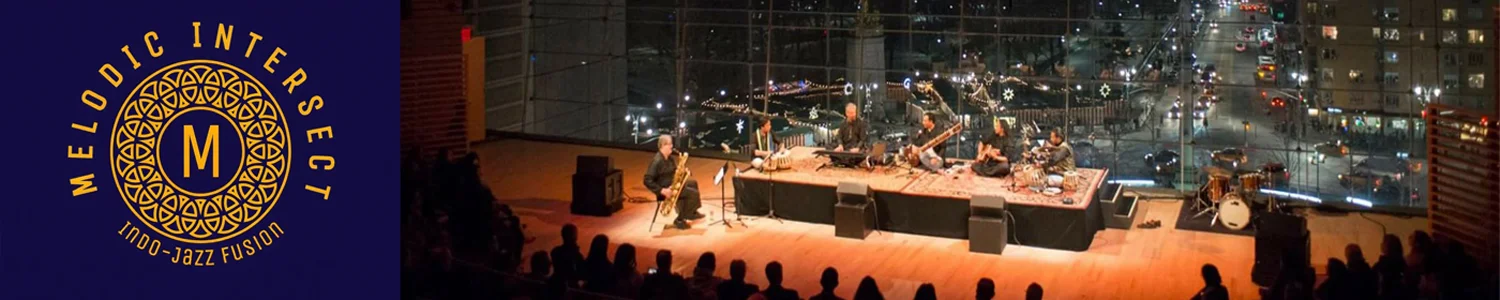
Melodic Intersect has recorded three tabla-and-piano duo albums: Hand-Talk (2021), Talking Hands (2022) and Hands Entwined (2023). On them, tabla player Enayet Hossain and pianist Greg Hatza trade the melody and the groove, with no bass or drum kit.
Hossain began studying tabla at six with his father, Ustad Hamid Hossain. Reviewing Talking Hands, JazzWeekly wrote that Hatza “plays a variety of keyboards to team with the hands of tabla man Enayet Hossain.” Start there, then compare the trio sound of Beyond Borders with sitar added.
How can I follow a taal while listening?
Find sam first: it is the beat the phrases resolve to and where the tabla’s bass is strongest. Then count the beats until the next landing. In teental you will count 16, and you will notice a lighter, “empty” feel in the third section: the khali.
Once you can hear the cycle, the improvisation becomes easier to follow, because you can hear when a soloist is building toward sam. For the wider background, see What Is Indian Jazz Fusion? To hear tabla live, book Melodic Intersect.