The sitar’s ringing, bending sound has been part of jazz for more than sixty years, from Ravi Shankar’s early-1960s sessions in Los Angeles to Miles Davis’s electric bands and today’s Indian jazz fusion groups. This guide explains how the instrument works, why it is both a gift and a challenge in jazz, and which records trace its path.
What makes the sitar sound the way it does?
A sitar has six or seven playing strings over curved, movable frets, and a second set of sympathetic strings underneath that ring on their own. A wide, curved bridge makes each string buzz with overtones, an effect called jawari. Together they give the sitar its shimmering sustain.
A sitar can carry 18 to 21 strings in all, and uses a gourd as its resonating chamber. Players pluck with a wire plectrum called a mizraab, worn on the finger.
Why is the sitar a challenge in jazz?
The sitar is built around a single tonal centre. Its drone and sympathetic strings are tuned to the raga being played, so fast jazz chord changes fight the instrument’s resonance. Jazz musicians who work with sitar usually slow the harmony down or build pieces on a mode.
The payoff is expressive range. With a technique called meend, a sitarist pulls the string sideways across a fret to bend a note by up to seven semitones, gliding between pitches the way a jazz saxophonist or vocalist would. That makes the sitar a natural lead voice over a groove.
When did the sitar first appear in jazz?
The first widely cited recorded meeting is Ravi Shankar’s Improvisations (released 1962), made with flautist Bud Shank and a Los Angeles jazz rhythm section. Earlier, in 1957, clarinettist Tony Scott recorded “Portrait of Ravi,” a tribute that shows jazz musicians were already listening.
John Coltrane’s “India” (recorded 1961) took a different route, imitating the drone with two basses rather than using Indian instruments. The full story of Shankar’s connection with jazz is in Ravi Shankar and Jazz.
How did British jazz use the sitar in the 1960s?
In London, composer John Mayer played sitar in Indo-Jazz Fusions, the double quintet he led with saxophonist Joe Harriott from the mid-1960s. Mayer’s sitar also opened “Acka Raga,” the group’s theme for the BBC quiz show Ask the Family, heard on British television from 1967 to 1984.
That group’s equal split between Indian and jazz musicians set a template for later bands. See Indo-Jazz Fusions: How Joe Harriott and John Mayer Named a Genre.
What happened to the sitar in 1970s fusion?
It went electric. Miles Davis’s On the Corner (1972) used two electric sitar players, Khalil Balakrishna and Collin Walcott, alongside Badal Roy on tabla. Walcott, who studied sitar with Ravi Shankar at UCLA, also played it in the bands Oregon, founded around 1970, and Codona, founded in 1978.
Critic Scott Yanow called Walcott “one of the first sitar players to play jazz.” He was killed in a bus crash while on tour with Oregon in 1984, aged 39.
Who plays sitar in jazz and fusion today?
Anoushka Shankar is the best-known sitarist crossing into other styles. She has received 14 Grammy nominations and appeared on Herbie Hancock’s The Imagine Project (2010). Other sitar players associated with jazz include Nishat Khan and Ashwin Batish.
Anoushka Shankar’s own records show the range: Rise (2005), Breathing Under Water (2007) with electronic producer Karsh Kale, Traveller (2011) with flamenco musicians, and the Chapter series from 2023 to 2025.
How does the sitar work with piano and tabla?
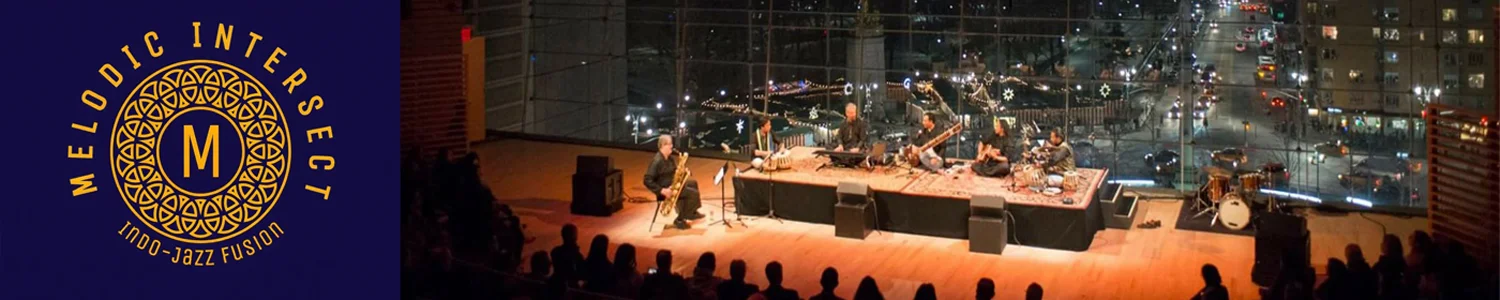
In Melodic Intersect, sitar player Hidayat Khan plays with tabla player Enayet Hossain and jazz pianist Greg Hatza. The sitar carries the raga and long melodic lines, the piano adds harmony and jazz phrasing, and the tabla drives the rhythmic cycle.
Khan comes from a family of sitar players spanning seven generations; his father was the sitar player Ustad Vilayat Khan. Hear the trio on Timeless Reflections (2024), Beyond Borders (2025) and Woven Paths (2026).
What should I listen to first?
For history, play Shankar and Bud Shank’s Improvisations, then Indo-Jazz Fusions, then Miles Davis’s On the Corner. For today’s sound, try Anoushka Shankar’s Traveller and Melodic Intersect’s Beyond Borders.
For the full background, read What Is Indian Jazz Fusion? To hear sitar, tabla and piano live, book Melodic Intersect.